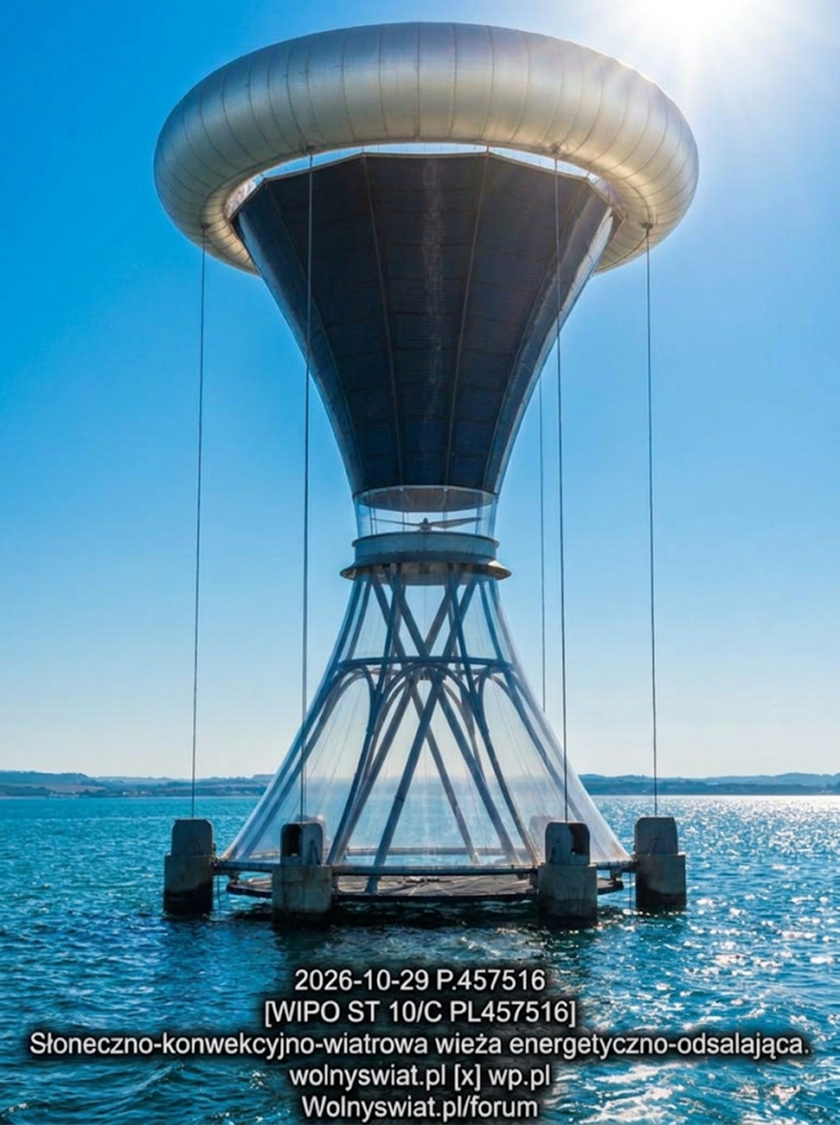
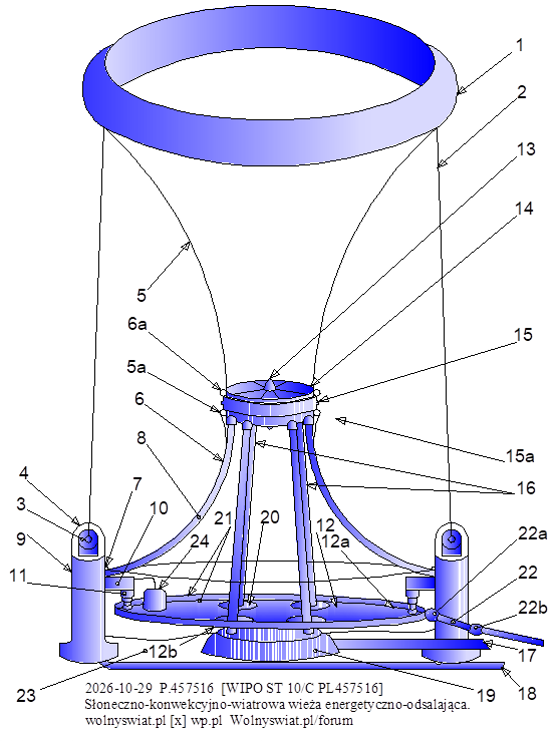
Small-scale version (visualization incomplete and unrefined)
Kleine Version (Visualisierung unvollständig, unausgereift)
Version réduite (visualisation incomplète)
小型版本(不完整,未完成的視覺化效果圖)
Xiǎoxíng bǎnběn (bù wánzhěng, wèi wánchéng de shìjué huà xiàoguǒ tú)
Краткая версия (неполная, незавершенная визуализация)
Kratkaya versiya (nepolnaya, nezavershennaya vizualizatsiya)
Wersja mała (wizualizacja niekompletna, niedopracowana)
Angielski (English)
2026-10-29
Application number: P.457516 [WIPO ST 10/C PL457516]
Applicant: Piotr Kołodyński, Mielno, Poland
Title of the invention: Solar-convective-wind power and desalination tower.
The tower produces extremely cheaply and completely waste-free:
• electricity at a cost of: approx. €0.012 – €0.021 / kWh, i.e. €12 – €21 / MWh (approx. 0.05 – 0.09 PLN/kWh / 50 – 90 PLN/MWh) (competitors offer: €0.09 – €0.20 / kWh in wholesale from offshore wind farms or conventional power plants, and for end users with grid transmission fees over €0.23 – €0.28 / kWh)
• fresh water, transported free of charge over a distance of several dozen kilometers thanks to the significant elevation at which it is generated, at a cost of: approx. €0.07 – €0.14 / m³ (approx. 0.30 – 0.60 PLN/m³) (competitors offer: €0.80 – €2.30 / m³ in industrial reverse osmosis or thermal desalination plants requiring costly pumping, and €1.40 – €3.50 / m³ in public water supply networks)
• concentrated brine at a price of: approx. €1.15 – €3.50 / m³ (approx. 5 – 15 PLN/m³) of concentrated solution (competitors offer: €14 – €58 / m³ depending on concentration and chemical, industrial, or balneological use, whereas in traditional desalination plants it represents a costly-to-dispose waste that contaminates the environment)
The tower, thanks to a narrowing in its middle section (forming a Venturi throat), ensures increased electricity generation efficiency by utilizing the latent heat of water vapor condensation (2260 kJ/kg) as well as the higher enthalpy and buoyancy of humid air, acting simultaneously as a desalination facility, brine generator, and a hydrostatic water tower providing gravitational supply of pure fresh water under high hydrostatic pressure.
The tower will include, among others:
• a buoyant lift balloon
• tethers/cables connecting the balloon with electric winches/motors to regulate the positioning of the buoyant balloon and pull it down in case of excessively strong winds
• a lower intake sleeve
• an upper exhaust sleeve attached to the balloon (optionally made of photovoltaic film)
• a ring with a collection gutter for condensing water from the inner surface of the upper sleeve, equipped with a coaxially mounted generator and rotor
• at least 3 internal ring support columns serving simultaneously as drainage channels delivering water gravitationally (without pumps) from a height of several dozen meters over a distance of several dozen kilometers
• at least 3 arched structural supports supporting the membrane of the lower intake sleeve
• a solar basin/tray attached to hydraulic actuators (at least 2, preferably 4 – 2 on each side) designed to adjust elevation (the tray can be cyclically raised to increase the temperature of water trapped on it, accelerating evaporation) and tilt angle (facilitating brine runoff)
• a tubular brine drain
• a vibration unit facilitating brine drainage and shaking off accumulated impurities/scale from the plate
The towers will be constructed in close proximity to shorelines, in natural or artificial bays and lagoons with continuous water inflow.
A double palisade may be installed around the tower: the outer wall protecting against waves and the inner wall partially shielding against wind, fitted with protective gates.
Maximum safe dimensions of the tower are: total height from 150 m to 500 m (in large-scale industrial configurations up to 800 – 1000 m), with the rigid lower section height reaching the Venturi throat at 40 – 120 m (providing a hydrostatic water column pressure of 4 – 12 bar), base diameter of 80 – 300 m, and throat constriction diameter of 15 – 60 m. Construction time will be: 3 to 6 months (enabled by modular prefabrication, replacement of heavy concrete with a frame-membrane structure, and rapid aerial assembly utilizing airships equipped with photovoltaic skins powering their electric propulsion engines).
Construction cost will range from: €3.5 to €10.5 million (approx. 15 to 45 million PLN) for a full-scale industrial unit (representing merely 10 – 20% of the cost of constructing a traditional reinforced-concrete solar updraft tower or an offshore wind farm paired with a conventional desalination plant of comparable capacity).
Durability of the upper and lower membranes will be: 15 – 25 years for the flexible upper membrane (protected against storm damage by retracting it onto the rigid lower cone) and 25 – 35 years for the segmented lower membrane supported on arched trusses (with low-cost and fast replacement of individual segment strips along assembly slots).
Durability of the remaining structural elements will reach: 50 – 80 years for the rigid hydrotechnical base, underwater foundations, collection gutter ring, and tubular structural supports made of acid-resistant stainless steel or marine-grade composites (with standard servicing of moving electro-mechanical assemblies, such as the generator with rotor, winch motors, and hydraulic cylinders, scheduled every 15 – 20 years).
JĘZYK ANGIELSKI (ENGLISH)
Production Capacity of the Solar-Convection-Wind Power and Desalination Tower (Patent Application P.457516)
The tower, depending on its size (small: height 200 m and base diameter 100 m; medium: height 450 m and base diameter 220 m; largest: height 850–1,000 m and base diameter 400–500 m), will produce:
electricity:
small size (1.5–2.5 MW capacity): 30–50 MWh per day (11,000–18,000 MWh per year),
medium size (12–18 MW capacity): 240–380 MWh per day (88,000–138,000 MWh per year),
largest size (50–75 MW capacity): 1,000–1,600 MWh per day (365,000–580,000 MWh per year);
water (clean fresh water from condensation):
small size: 150–300 m3 (tons) per day (55,000–110,000 m3 per year),
medium size: 900–1,600 m3 (tons) per day (330,000–580,000 m3 per year),
largest size: 4,500–8,000 m3 (tons) per day (1,650,000–2,900,000 m3 per year);
brine (25% concentrated industrial brine or calculated as dry salt and minerals):
small size: 20–42 tons of dense brine per day, i.e., 7,500–15,000 tons per year (equivalent to 5.2–10.5 tons of dry salt per day, or 1,900–3,800 tons per year),
medium size: 125–225 tons of dense brine per day, i.e., 45,000–82,000 tons per year (equivalent to 31–56 tons of dry salt per day, or 11,500–20,500 tons per year),
largest size: 630–1,120 tons of dense brine per day, i.e., 230,000–408,000 tons per year (equivalent to 157–280 tons of dry salt per day, or 57,000–102,000 tons per year).
Detailed Technical and Production Specifications:
Small size (local / island / coastal unit): Total height 200 m (rigid lower base 45 m), base diameter 100 m (area 7,850 m2), Venturi throat diameter 18 m. Continuous 24/7 operation supplies electricity for 5,000–8,000 households, gravity-fed fresh water without pumps, and valuable mineral brine (containing magnesium, potassium, bromine, and lithium).
Medium size (regional / industrial unit): Total height 450 m (rigid base 80 m), base diameter 220 m (area 38,000 m2), Venturi throat diameter 40 m. Powers a city of 40,000–65,000 inhabitants, provides water for municipal and agricultural irrigation, and supplies chemical plants with concentrated brine without discharging waste back into the sea.
Largest size (large-scale / strategic unit): Total height 850–1,000 m (rigid base 120 m, upper sleeve supported by a buoyancy balloon), base diameter 400–500 m (area 125,000–196,000 m2), Venturi throat diameter 65 m. Powers 180,000–280,000 inhabitants or a major industrial hub, eliminates coastal water deficits at zero external energy cost, and enables profitable extraction of critical raw materials (such as lithium and magnesium).
Salinity note: Brine and salt yields are calculated for standard ocean salinity (approx. 3.5%, or 35 kg of salt per 1 m3). In low-salinity seas such as the Baltic Sea (0.7–0.8%), electricity and fresh water output remain identical, while brine and salt volume is approx. 4.5 times lower.
Niemiecki (Deutsch)
2026-10-29
Anmeldenummer: P.457516 [WIPO ST 10/C PL457516]
Anmelder: Piotr Kołodyński, Mielno, Polen
Bezeichnung der Erfindung: Solar-Konvektions-Wind-Energie- und Entsalzungsturm.
Der Turm erzeugt extrem günstig und vollständig abfallfrei:
• Strom zu einem Preis von: ca. 0,012 – 0,021 €/kWh, d. h. 12 – 21 €/MWh (ca. 0,05 – 0,09 PLN/kWh / 50 – 90 PLN/MWh) (Wettbewerber bieten im Großhandel aus Offshore-Windparks oder konventionellen Kraftwerken Strom zu 0,09 – 0,20 €/kWh an, für Endverbraucher inklusive Netzentgelte über 0,23 – 0,28 €/kWh)
• Süßwasser, das dank der großen Höhe, in der es erzeugt wird, kostenlos über mehrere Dutzend Kilometer transportiert werden kann, zu einem Preis von: ca. 0,07 – 0,14 €/m³ (ca. 0,30 – 0,60 PLN/m³) (Wettbewerber verlangen: 0,80 – 2,30 €/m³ in industriellen Umkehrosmose- oder thermischen Entsalzungsanlagen mit aufwendigen Pumpvorgängen, und in Trinkwassernetzen 1,40 – 3,50 €/m³)
• Sole zu einem Preis von: ca. 1,15 – 3,50 €/m³ (ca. 5 – 15 PLN/m³) konzentrierter Lösung (Wettbewerber berechnen: 14 – 58 €/m³ je nach Konzentration und Verwendungszweck für Chemie, Industrie oder Balneologie; bei herkömmlichen Entsalzungsanlagen stellt sie zudem einen teuer zu entsorgenden und umweltschädlichen Abfall dar)
Der Turm gewährleistet dank einer Verengung im Mittelteil (die eine Venturi-Düse bildet) einen gesteigerten Wirkungsgrad bei der Stromerzeugung durch Nutzung der latenten Kondensationswärme von Wasserdampf (2260 kJ/kg) sowie der höheren Enthalpie und des Auftriebs feuchter Luft. Er fungiert gleichzeitig als Meerwasserentsalzungsanlage, Soleerzeuger und hydrostatischer Wasserturm, der eine Schwerkraftabgabe von reinem Süßwasser unter hohem hydrostatischem Druck ermöglicht.
Der Turm umfasst unter anderem:
• einen Auftriebsballon
• Seile, die den Ballon mit Elektromotoren verbinden, um die Ausrichtung des Auftriebsballons zu regulieren und ihn bei zu starkem Wind nach unten einzuholen
• eine untere Einlasshülle
• eine obere Auslasshülle, die am Ballon befestigt ist (kann aus Photovoltaikfolie gefertigt sein)
• einen Sammelring mit Rinne für das an der Innenfläche der oberen Hülle kondensierende Wasser, ausgestattet mit einem koaxial montierten Generator mit Rotor
• mindestens 3 innere Ringstützen, die gleichzeitig als Ableitungskanäle dienen, um das Wasser aus einer Höhe von mehreren Dutzend Metern gravitationsgetrieben (ohne Pumpen) über eine Distanz von mehreren Dutzend Kilometern zu transportieren
• mindestens 3 Bogenträger zur Abstützung der Hülle des Einlasstrichters
• eine solare Wanne/Plattform, befestigt an hydraulischen Stellzylindern (mindestens 2, vorzugsweise 4 – jeweils 2 auf jeder Seite) zur Höhenverstellung (die Wanne kann zyklisch angehoben werden, um die Temperatur des darauf gehaltenen Wassers zu erhöhen und so die Verdunstungsrate zu steigern) und zur Neigungswinkelregulierung (zur Erleichterung des Soleabflusses)
• einen rohrförmigen Soleablauf
• einen Vibrator zur Förderung des Soleabflusses und zum Abschütteln von Verunreinigungen von der Wanne
Die Türme werden in unmittelbarer Ufernähe, in natürlichen oder künstlichen Buchten sowie Überschwemmungsgebieten mit ständigem Wasserzufluss errichtet.
Um den Turm herum kann eine doppelte Palisade angeordnet werden: eine äußere zum Schutz vor Wellengang und eine innere, die teilweise vor Wind schützt, ausgestattet mit Schutzschleusentoren.
Die maximalen sicheren Abmessungen des Turms betragen: Gesamthöhe von 150 m bis 500 m (in großindustriellen Anlagen bis zu 800 – 1000 m), bei einer Höhe des starren Unterteils bis zur Venturi-Kehle von 40 – 120 m (was einen hydrostatischen Wassersäulendruck von ca. 4 – 12 bar ergibt), einem Basisdurchmesser von 80 – 300 m sowie einem Verengungsdurchmesser in der Kehle von 15 – 60 m. Die Bauzeit des Turms beträgt: 3 bis 6 Monate (dank modularer Vorfertigung, Ersatz von schwerem Beton durch eine leichte Skelett-Membran-Konstruktion sowie schneller Montage aus der Luft mithilfe von Luftschiffen mit Photovoltaikhülle zur Speisung ihrer elektrischen Antriebsmotoren).
Die Baukosten belaufen sich auf: 3,5 bis 10,5 Mio. Euro (ca. 15 bis 45 Mio. PLN) für eine vollskalige Industrieanlage (was lediglich 10 – 20 % der Kosten eines traditionellen Stahlbeton-Aufwindkraftwerks oder eines Offshore-Windparks kombiniert mit einer klassischen Entsalzungsanlage vergleichbarer Leistung entspricht).
Die Lebensdauer der oberen und unteren Hülle beträgt: 15 – 25 Jahre für die flexible obere Membran (geschützt vor Sturmschäden durch Herunterziehen auf den starren unteren Kegel) sowie 25 – 35 Jahre für die auf Bogenträgern gelagerte segmentierte untere Membran (mit kostengünstiger und schneller Austauschbarkeit einzelner Segmentbahnen in Montageschlitzen).
Die Lebensdauer der übrigen Konstruktionselemente beträgt: 50 – 80 Jahre für den starren hydrotechnischen Unterbau, Fundamente, die Sammelrinne und rohrförmige Trägerelemente aus säurebeständigem Edelstahl oder meerwasserresistenten Verbundwerkstoffen (bei standardmäßiger Wartung beweglicher Komponenten wie Generator mit Rotor, Seilwindenmotoren und Hydraulikzylindern alle 15 – 20 Jahre).
Produktionsleistung des Solar-Konvektions-Wind-Energie- und Entsalzungsturms (Patentanmeldung P.457516)
Der Turm produziert je nach seiner Größe (klein: Höhe 200 m und Basisdurchmesser 100 m; mittel: Höhe 450 m und Basisdurchmesser 220 m; am größten: Höhe 850–1.000 m und Basisdurchmesser 400–500 m):
Strom:
kleine Baugröße (Leistung 1,5–2,5 MW): 30–50 MWh pro Tag (11.000–18.000 MWh pro Jahr),
mittlere Baugröße (Leistung 12–18 MW): 240–380 MWh pro Tag (88.000–138.000 MWh pro Jahr),
größte Baugröße (Leistung 50–75 MW): 1.000–1.600 MWh pro Tag (365.000–580.000 MWh pro Jahr);
Wasser (reines Süßwasser aus Kondensation):
kleine Baugröße: 150–300 m3 (Tonnen) pro Tag (55.000–110.000 m3 pro Jahr),
mittlere Baugröße: 900–1.600 m3 (Tonnen) pro Tag (330.000–580.000 m3 pro Jahr),
größte Baugröße: 4.500–8.000 m3 (Tonnen) pro Tag (1.650.000–2.900.000 m3 pro Jahr);
Sole (25 % konzentrierte Industriesole oder umgerechnet in Trockensalz und Mineralien):
kleine Baugröße: 20–42 Tonnen dichte Sole pro Tag, d. h. 7.500–15.000 Tonnen pro Jahr (entspricht 5,2–10,5 Tonnen Trockensalz pro Tag bzw. 1.900–3.800 Tonnen pro Jahr),
mittlere Baugröße: 125–225 Tonnen dichte Sole pro Tag, d. h. 45.000–82.000 Tonnen pro Jahr (entspricht 31–56 Tonnen Trockensalz pro Tag bzw. 11.500–20.500 Tonnen pro Jahr),
größte Baugröße: 630–1.120 Tonnen dichte Sole pro Tag, d. h. 230.000–408.000 Tonnen pro Jahr (entspricht 157–280 Tonnen Trockensalz pro Tag bzw. 57.000–102.000 Tonnen pro Jahr).
Detaillierte technische und produktionsbezogene Spezifikation:
Kleine Baugröße (lokale / Insel- / Küsteneinheit): Gesamthöhe 200 m (starre Basis 45 m), Basisdurchmesser 100 m (Fläche 7.850 m2), Venturi-Kehlungsdurchmesser 18 m. Der 24/7-Dauerbetrieb versorgt 5.000–8.000 Haushalte mit Strom, liefert druckgeführtes Süßwasser über die Schwerkraft ohne Pumpen sowie wertvolle Mineralsole (Magnesium, Kalium, Brom, Lithium).
Mittlere Baugröße (regionale / industrielle Einheit): Gesamthöhe 450 m (starre Basis 80 m), Basisdurchmesser 220 m (Fläche 38.000 m2), Venturi-Kehlungsdurchmesser 40 m. Deckt den Strombedarf einer Stadt mit 40.000–65.000 Einwohnern, liefert Wasser für Kommunen und Landwirtschaft und versorgt Chemieanlagen mit konzentrierter Sole ohne schädliche Rückleitung ins Meer.
Größte Baugröße (großtechnische / strategische Einheit): Gesamthöhe 850–1.000 m (starre Basis 120 m, oberer Schlauch durch Auftriebsballon gehalten), Basisdurchmesser 400–500 m (Fläche 125.000–196.000 m2), Venturi-Kehlungsdurchmesser 65 m. Versorgt 180.000–280.000 Einwohner oder ein großes Industriecluster, beseitigt Trinkwasserdefizite ohne externe Energiekosten und ermöglicht die rentable Gewinnung kritischer Rohstoffe (wie Lithium und Magnesium).
Hinweis zum Salzgehalt: Die Sole- und Salzmengen gelten für Standard-Ozeanwasser (ca. 3,5 % Salzgehalt bzw. 35 kg Salz pro 1 m3). In der Ostsee (0,7–0,8 % Salzgehalt) bleibt die Strom- und Süßwasserproduktion gleich, während die Sole- und Salzmenge etwa 4,5-mal geringer ausfällt.
Francuski (Français)
2026-10-29
Numéro de dépôt : P.457516 [WIPO ST 10/C PL457516]
Demandeur : Piotr Kołodyński, Mielno, Pologne
Titre de l'invention : Tour énergétique et de dessalement solaire-convective-éolienne.
La tour produit à un coût extrêmement bas et sans aucun déchet :
• de l'électricité au prix de : env. 0,012 – 0,021 €/kWh, soit 12 – 21 €/MWh (env. 0,05 – 0,09 PLN/kWh / 50 – 90 PLN/MWh) (la concurrence propose : 0,09 – 0,20 €/kWh sur le marché de gros des parcs éoliens en mer ou des centrales conventionnelles, et plus de 0,23 – 0,28 €/kWh pour les consommateurs finaux avec les coûts de réseau)
• de l'eau douce, acheminée gratuitement sur plusieurs dizaines de kilomètres grâce à la grande hauteur à laquelle elle est produite, au prix de : env. 0,07 – 0,14 €/m³ (env. 0,30 – 0,60 PLN/m³) (la concurrence propose : 0,80 – 2,30 €/m³ dans les usines de dessalement thermique ou à osmose inverse nécessitant un pompage coûteux, et 1,40 – 3,50 €/m³ dans les réseaux de distribution d'eau potable)
• de la saumure au prix de : env. 1,15 – 3,50 €/m³ (env. 5 – 15 PLN/m³) de solution concentrée (la concurrence propose : 14 – 58 €/m³ selon la concentration et les applications chimiques, industrielles ou balnéologiques, sachant que dans les usines de dessalement classiques, elle constitue un déchet polluant très coûteux à retraiter)
La tour, grâce à un rétrécissement dans sa partie médiane (formant un col de Venturi), assure une efficacité accrue de production d'électricité grâce à l'exploitation de la chaleur latente de condensation de la vapeur d'eau (2260 kJ/kg) ainsi qu'à l'enthalpie et à la poussée aérostatique accrues de l'air humide, fonctionnant simultanément comme usine de dessalement, unité de production de saumure et château d'eau hydrostatique assurant la distribution gravitaire d'eau douce sous haute pression hydrostatique.
La tour comprendra notamment :
• un ballon aérostatique porteur
• des câbles reliant le ballon à des moteurs électriques pour ajuster la position du ballon et le descendre en cas de vent trop fort
• un manchon d'admission inférieur
• un manchon d'évacuation supérieur fixé au ballon (pouvant être réalisé en film photovoltaïque)
• un anneau collecteur avec goulotte pour l'eau condensée sur la paroi interne du manchon supérieur, doté d'un générateur coaxial avec rotor
• au moins 3 piliers internes supportant l'anneau, faisant également office de conduites d'évacuation gravitaire (sans pompes) de l'eau depuis plusieurs dizaines de mètres de hauteur sur une distance de plusieurs dizaines de kilomètres
• au moins 3 supports en arc soutenant la membrane du manchon d'admission
• un bassin/plateau solaire fixé à des vérins hydrauliques (au moins 2, idéalement 4 – soit 2 de chaque côté) pour ajuster la hauteur (le plateau peut être élevé périodiquement pour accroître la température de l'eau retenue et accélérer l'évaporation) et l'angle d'inclinaison (facilitant l'écoulement de la saumure)
• une conduite d'évacuation de la saumure
• un vibreur facilitant l'écoulement de la saumure et délogeant les dépôts/impuretés du plateau
Les tours seront construites à proximité immédiate des côtes, dans des baies naturelles ou artificielles et des lagunes alimentées en eau continue.
Une double palissade peut être installée autour de la tour : la paroi extérieure protégeant contre les vagues et la paroi intérieure coupant partiellement le vent, équipée de portes de sécurité.
Les dimensions maximales sécurisées de la tour sont : hauteur totale de 150 m à 500 m (jusqu'à 800 – 1000 m pour les installations industrielles de grande envergure), avec une base rigide jusqu'au col de Venturi de 40 – 120 m (générant une pression hydrostatique de 4 – 12 bars), un diamètre de base de 80 – 300 m et un diamètre d'étranglement de 15 – 60 m. Le temps de construction sera de : 3 à 6 mois (grâce à la préfabrication modulaire, au remplacement du béton lourd par une structure légère toile-armature et à la possibilité de montage aérien rapide par dirigeables à enveloppe photovoltaïque alimentant leurs moteurs de propulsion électriques).
Le coût de construction de la tour sera de : 3,5 à 10,5 millions d'euros (env. 15 à 45 millions de PLN) pour une unité industrielle complète (soit seulement 10 – 20 % du coût de construction d'une tour solaire classique en béton armé ou d'un parc éolien offshore couplé à une usine de dessalement conventionnelle de taille similaire).
La durabilité des membranes supérieure et inférieure sera de : 15 – 25 ans pour la membrane supérieure souple (protégée des tempêtes par rétractation sur le cône rigide inférieur) et de 25 – 35 ans pour la membrane inférieure segmentée reposant sur des arcs porteurs (avec remplacement aisé et rapide des bandes segmentées dans des fentes de montage).
La durabilité des autres éléments structurels sera de : 50 – 80 ans pour le soubassement hydrotechnique rigide, les fondations sous-marines, l'anneau collecteur et les supports tubulaires en acier inoxydable résistant aux acides ou en matériaux composites marins (avec entretien standard des ensembles mobiles tels que génératrice, treuils et vérins tous les 15 – 20 ans).
Capacité de production de la tour énergétique et de dessalement solaire-convection-éolienne (Demande de brevet P.457516)
La tour, selon sa taille (petite : hauteur 200 m et diamètre de base 100 m ; moyenne : hauteur 450 m et diamètre de base 220 m ; la plus grande : hauteur 850–1 000 m et diamètre de base 400–500 m), produira :
électricité :
petite taille (puissance 1,5–2,5 MW) : 30–50 MWh par jour (11 000–18 000 MWh par an),
taille moyenne (puissance 12–18 MW) : 240–380 MWh par jour (88 000–138 000 MWh par an),
la plus grande taille (puissance 50–75 MW) : 1 000–1 600 MWh par jour (365 000–580 000 MWh par an) ;
eau (eau douce pure issue de la condensation) :
petite taille : 150–300 m3 (tonnes) par jour (55 000–110 000 m3 par an),
taille moyenne : 900–1 600 m3 (tonnes) par jour (330 000–580 000 m3 par an),
la plus grande taille : 4 500–8 000 m3 (tonnes) par jour (1 650 000–2 900 000 m3 par an) ;
saumure (saumure industrielle concentrée à 25 % ou convertie en sel sec et minéraux) :
petite taille : 20–42 tonnes de saumure dense par jour, soit 7 500–15 000 tonnes par an (équivalent à 5,2–10,5 tonnes de sel sec par jour, ou 1 900–3 800 tonnes par an),
taille moyenne : 125–225 tonnes de saumure dense par jour, soit 45 000–82 000 tonnes par an (équivalent à 31–56 tonnes de sel sec par jour, ou 11 500–20 500 tonnes par an),
la plus grande taille : 630–1 120 tonnes de saumure dense par jour, soit 230 000–408 000 tonnes par an (équivalent à 157–280 tonnes de sel sec par jour, ou 57 000–102 000 tonnes par an).
Spécifications techniques et de production détaillées :
Petite taille (unité locale / insulaire / côtière) : Hauteur totale 200 m (base rigide 45 m), diamètre de base 100 m (surface 7 850 m2), diamètre du col de Venturi 18 m. Le fonctionnement continu 24h/24 alimente 5 000 à 8 000 foyers en électricité, fournit de l'eau douce par gravité sans pompes et produit une saumure riche en minéraux (magnésium, potassium, brome, lithium).
Taille moyenne (unité régionale / industrielle) : Hauteur totale 450 m (base rigide 80 m), diamètre de base 220 m (surface 38 000 m2), diamètre du col de Venturi 40 m. Alimente une ville de 40 000 à 65 000 habitants, assure l'irrigation agricole et fournit aux usines chimiques une matière première gratuite sans rejet polluant en mer.
La plus grande taille (unité à grande échelle / stratégique) : Hauteur totale 850–1 000 m (base rigide 120 m, gaine supérieure maintenue par un ballon de flottabilité), diamètre de base 400–500 m (surface 125 000–196 000 m2), diamètre du col de Venturi 65 m. Alimente 180 000 à 280 000 habitants ou un pôle industriel, résout les pénuries d'eau sans coût énergétique externe et permet l'extraction rentable de métaux critiques (lithium, magnésium).
Note sur la salinité : Calculé pour une salinité océanique standard (environ 3,5 %, soit 35 kg de sel par m3). Pour la mer Baltique (0,7–0,8 %), la production d'électricité et d'eau douce reste identique, tandis que la quantité de saumure et de sel est environ 4,5 fois inférieure.
Polski
2026-10-29
Zgłoszenie oznaczono numerem: P.457516 [WIPO ST 10/C PL457516]
Zgłaszający: Piotr Kołodyński, Mielno, Polska
Tytuł wynalazku: Słoneczno-konwekcyjno-wiatrowa wieża energetyczno-odsalająca.
Wieża wytwarza niezwykle tanio i całkowicie bezodpadowo:
• prąd w cenie: ok. 0,05 – 0,09 zł/kWh, czyli 50 – 90 zł/MWh (konkurencja oferuje w cenie: 0,40 – 0,85 zł/kWh w hurcie z morskich farm wiatrowych lub elektrowni konwencjonalnych, a dla odbiorców końcowych z kosztami przesyłu ponad 1,00 – 1,20 zł/kWh)
• słodką wodę, transportowaną za darmo dzięki dużej wysokości na której jest wytwarzana na odległość kilkudziesięciu kilometrów, w cenie: ok. 0,30 – 0,60 zł/m³ (konkurencja oferuje w cenie: 3,50 – 10,00 zł/m³ w przemysłowych odsalarniach odwróconej osmozy lub termicznych wymagających kosztownego pompowania, a w sieciach wodociągowych 6,00 – 15,00 zł/m³)
• solankę w cenie: ok. 5 – 15 zł/m³ zatężonego roztworu (konkurencja oferuje w cenie: 60 – 250 zł/m³ w zależności od stężenia i przeznaczenia chemicznego, przemysłowego lub balneologicznego, przy czym w tradycyjnych odsalarniach stanowi ona kosztowny w utylizacji odpad skażający środowisko)
Wieża, dzięki przewężeniu w części środkowej (tworzącym gardziel Venturiego), zapewnia zwiększoną sprawność wytwarzania energii elektrycznej dzięki wykorzystaniu ciepła utajonego kondensacji pary wodnej (2260 kJ/kg) oraz wyższej entalpii i wyporności wilgotnego powietrza, działającej jednocześnie jako odsalarnia, wytwornica solanki i hydrostatyczna wieża ciśnień zapewniająca grawitacyjny odbiór czystej wody słodkiej pod wysokim ciśnieniem hydrostatycznym.
Wieża będzie posiadać m.in.:
• balon wypornościowy
• liny łączące balon z silnikami elektrycznymi do regulacji ustawienia balonu wypornościowego oraz ściągania go na dół w razie zbyt silnego wiatru
• rękaw dolny wlotowy
• rękaw górny wylotowy przytwierdzony do balonu (może być wykonany z fotowoltaicznej folii)
• pierścień z korytem dla skraplającej się wody z wewnętrznej powierzchni rękawa górnego oraz mający współosiowo zamontowaną prądnicę z wirnikiem
• co najmniej 3 wewnętrzne wsporniki pierścienia stanowiące jednocześnie kanały odprowadzające z wysokości kilkudziesięciu metrów grawitacyjnie (czyli bez pomp) z jego koryta wodę na odległość kilkudziesięciu kilometrów
• co najmniej 3 wsporniki łukowe podpierające powłokę rękawa wlotowego
• solarną tacę przytwierdzoną do hydraulicznych siłowników (co najmniej 2, ale najlepiej 4 – po 2 z każdej strony) służących do regulowania wysokości (taca może być cyklicznie unoszona, aby zwiększyć temperaturę uwięzionej na niej wody, co zwiększy tempo parowania wody) i kąta usytuowania tacy (co ułatwi odpływ solanki)
• rurowy odpływ solanki
• wibrator ułatwiający spływ solanki oraz służący do strząsania zanieczyszczeń z płyty
Wieże będą budowane w bliskiej odległości od brzegu, w naturalnych, sztucznych zatokach, zalewiskach z dopływem wody.
Wokół wieży może być osadzona podwójna palisada, zewnętrzna chroniąca przed falami, a wewnętrzna, częściowo, przed wiatrem, z wrotami ochronnymi.
Maksymalne bezpieczne rozmiary wieży wynoszą: wysokość całkowita od 150 m do 500 m (w układach wielkoskalowych do 800 – 1000 m), przy wysokości sztywnej części dolnej do gardzieli Venturiego 40 – 120 m (co daje ciśnienie hydrostatyczne słupa wody rzędu 4 – 12 barów), średnicy podstawy 80 – 300 m oraz średnicy przewężenia w gardzieli 15 – 60 m. Czas budowy wieży wyniesie: od 3 do 6 miesięcy (dzięki prefabrykacji modułowej, zastąpieniu ciężkiego betonu konstrukcją szkieletowo-powłokową oraz możliwości szybkiego montażu z powietrza przy użyciu sterowców z powłoką fotowoltaiczną zasilającą ich elektryczne silniki napędowe).
Koszt budowy wieży wyniesie: od 15 do 45 mln zł dla pełnoskalowej jednostki przemysłowej (czyli zaledwie 10 – 20% kosztu wzniesienia tradycyjnej żelbetowej wieży słonecznej lub morskiej farmy wiatrowej połączonej z klasyczną odsalarnią o porównywalnych parametrach).
Trwałość powłoki górnej i dolnej wyniesie: 15 – 25 lat dla elastycznej powłoki górnej (chronionej przed niszczącym działaniem sztormów poprzez jej ściąganie na sztywny stożek dolny) oraz 25 – 35 lat dla spoczywającej na wspornikach łukowych segmentowej powłoki dolnej (z możliwością taniej i szybkiej wymiany pojedynczych pasów segmentowych w szczelinach montażowych).
Trwałość pozostałych elementów konstrukcji wyniesie: 50 – 80 lat dla sztywnej podbudowy hydrotechnicznej, fundamentów dennych, koryta pierścieniowego i wsporników rurowych wykonanych ze stali kwasoodpornej lub kompozytów odpornych na wodę morską (przy standardowym serwisowaniu podzespołów ruchomych, takich jak prądnica z wirnikiem, silniki bębnów i siłowniki, co 15 – 20 lat).
Wieża, zależnie od jej wielkości (mała: wysokość 200 m i średnica podstawy 100 m; średnia: wysokość 450 m i średnica podstawy 220 m; największa: wysokość 850–1 000 m i średnica podstawy 400–500 m), wyprodukuje:
• prądu:
o rozmiar mały (moc 1,5–2,5 MW): 30–50 MWh na dobę (11 000–18 000 MWh rocznie),
o rozmiar średni (moc 12–18 MW): 240–380 MWh na dobę (88 000–138 000 MWh rocznie),
o rozmiar największy (moc 50–75 MW): 1 000–1 600 MWh na dobę (365 000–580 000 MWh rocznie);
• wody (czystej wody słodkiej ze skraplania):
o rozmiar mały: 150–300 m3 (ton) na dobę (55 000–110 000 m3 rocznie),
o rozmiar średni: 900–1 600 m3 (ton) na dobę (330 000–580 000 m3 rocznie),
o rozmiar największy: 4 500–8 000 m3 (ton) na dobę (1 650 000–2 900 000 m3 rocznie);
• solanki (zagęszczonej solanki przemysłowej 25% lub w przeliczeniu na suchą sól i minerały):
o rozmiar mały: 20–42 ton gęstej solanki na dobę, czyli 7 500–15 000 ton rocznie (co odpowiada 5,2–10,5 tony suchej soli na dobę, czyli 1 900–3 800 ton rocznie),
o rozmiar średni: 125–225 ton gęstej solanki na dobę, czyli 45 000–82 000 ton rocznie (co odpowiada 31–56 tonom suchej soli na dobę, czyli 11 500–20 500 ton rocznie),
o rozmiar największy: 630–1 120 ton gęstej solanki na dobę, czyli 230 000–408 000 ton rocznie (co odpowiada 157–280 tonom suchej soli na dobę, czyli 57 000–102 000 ton rocznie).
Szczegółowa specyfikacja techniczno-produkcyjna dla poszczególnych rozmiarów:
1. Rozmiar mały (jednostka lokalna / wyspowa / przybrzeżna)
• Wymiary konstrukcyjne: wysokość całkowita z elastycznym rękawem 200 m (sztywna baza dolna 45 m), średnica podstawy i tacy solarnej 100 m (powierzchnia podstawy około 7 850 m2), średnica przewężenia w gardzieli Venturiego 18 m.
• Produkcja prądu: 30–50 MWh na dobę (11–18 GWh rocznie). Zabezpiecza całkowite zapotrzebowanie na energię elektryczną dla 5 000–8 000 gospodarstw domowych. Dzięki akumulacji ciepła w wodzie na tacy solarnej oraz wykorzystaniu wiatru wieża pracuje w trybie ciągłym (24 godziny na dobę).
• Produkcja czystej wody: 150–300 m3 na dobę (55 000–110 000 m3 rocznie). Woda skrapla się w wyższych, chłodniejszych partiach wieży i spływa grawitacyjnie rurami konstrukcyjnymi pod ciśnieniem, bez konieczności używania pomp.
• Produkcja solanki: 20–42 ton na dobę (7 500–15 000 ton rocznie) nasyconej solanki 25% odbieranej grawitacyjnie z opuszczanej tacy solarnej. W przypadku całkowitego odparowania daje to 1 900–3 800 ton suchej soli morskiej (wraz z cennymi związkami magnezu, potasu, bromu i litu) rocznie.
2. Rozmiar średni (jednostka regionalna / przemysłowa)
• Wymiary konstrukcyjne: wysokość całkowita 450 m (sztywna baza dolna 80 m), średnica podstawy i tacy solarnej 220 m (powierzchnia około 38 000 m2), średnica przewężenia w gardzieli Venturiego 40 m.
• Produkcja prądu: 240–380 MWh na dobę (88–138 GWh rocznie). Wydajność rośnie nieliniowo względem małej wieży, ponieważ przy wysokości 450 m występuje znacznie większa różnica ciśnień i temperatur oraz silniejszy wiatr na pułapie wylotowym, co potęguje efekt kominowy. Pokrywa zapotrzebowanie miasta liczącego 40 000–65 000 mieszkańców.
• Produkcja czystej wody: 900–1 600 m3 na dobę (330 000–580 000 m3 rocznie). Taka ilość pozwala na równoczesne zaopatrzenie ludności oraz całoroczne nawadnianie dużych kompleksów szklarniowych lub upraw rolniczych w regionach suchych.
• Produkcja solanki: 125–225 ton na dobę (45 000–82 000 ton rocznie) gęstej solanki 25% (lub 11 500–20 500 ton suchej soli i minerałów rocznie). Stanowi to gotowy, darmowy wsad surowcowy dla zakładów chemicznych (produkcja sody, chloru, wodorotlenku sodu) bez zrzutu szkodliwych stężeń z powrotem do morza.
3. Rozmiar największy (jednostka wielkoskalowa / strategiczna)
• Wymiary konstrukcyjne: wysokość całkowita 850–1 000 m (sztywna baza dolna 120 m, górny rękaw utrzymywany przez wielkogabarytowy balon wypornościowy), średnica podstawy i strefy parowania 400–500 m (powierzchnia 125 000–196 000 m2), średnica przewężenia w gardzieli Venturiego 65 m.
• Produkcja prądu: 1 000–1 600 MWh na dobę (365–580 GWh rocznie). Na wysokości około 1 000 m temperatura powietrza jest niższa o 6,5 do 9 stopni Celsjusza względem poziomu morza, a stałe, silne wiatry wywołują gigantyczne podciśnienie ssące u wylotu wieży. Jedna taka jednostka zasila miasto o wielkości 180 000–280 000 mieszkańców lub duży klaster przemysłowy.
• Produkcja czystej wody: 4 500–8 000 m3 na dobę (1,65–2,9 mln m3 rocznie). Rozwiązuje problem deficytu wody pitnej i przemysłowej dla całej aglomeracji przybrzeżnej przy zerowym koszcie energii zewnętrznej na odsalanie.
• Produkcja solanki: 630–1 120 ton na dobę (230 000–408 000 ton rocznie) gęstej solanki 25% (lub 57 000–102 000 ton suchej soli i minerałów rocznie). Przy tej skali odzysk pierwiastków krytycznych z solanki (takich jak lit do akumulatorów czy magnez) staje się wysoce dochodową gałęzią przemysłu wydobywczego bez konieczności budowy kopalń odkrywkowych.
Uwaga dla warunków Morza Bałtyckiego: Powyższe ilości solanki i soli wyliczono dla standardowych mórz i oceanów (zasolenie około 3,5%). W przypadku posadowienia wieży nad Bałtykiem (zasolenie około 0,7–0,8%) produkcja prądu i czystej wody pozostaje na tym samym poziomie (a parowanie zachodzi nawet nieco szybciej ze względu na niższą gęstość wody), natomiast ilość uzyskiwanej solanki i soli będzie około 4,5-krotnie mniejsza.
| IUP - G (Interaktywny Uniwersalny Program - Gemini) - Wolnyswiat.pl - Piotr Kołodyński
Moje patenty Meine Patente My patents
https://wolnyswiat.pl/forum/viewforum.php?f=9